WRITING
Every Bet in Your Favor, Yet Still Bankrupt: Position Sizing Is Destiny
A gamble that favors you every single round — yet, played long enough, drives you to zero with probability 1. Not a scam, not a hidden cost, the math is crystal clear — and it nearly went unnoticed, because the answer is so counterintuitive that almost everyone's first reaction is "you must have calculated wrong."
The gamble looks like this: 50% win probability each round, a win more than doubles your stake, a loss costs you half. Compute the expectation — for every 1 you wager, you get back 1.05 on average. Every single round is in your favor.
A reasonable person will jump to the conclusion: bet heavy, the bigger the stake, the bigger the payoff.
And then they go broke. Not from bad luck — from betting too big.
The critical error hides inside the word "average." That 1.05 comes from taking ten thousand people who each play one round and averaging their outcomes — some double, some get halved, and the sum tilts upward. The number is real, but it is not your number.
You are not ten thousand people. You are one person, wagering the same capital on the same gamble over and over. You walk a single path: this round's outcome is next round's principal. Take one heavy hit along the way, and you don't recover "on average" — you restart from a smaller base.
Loss asymmetry — that is the whole secret
The distinction hides in a piece of elementary arithmetic:
| What you experience | What intuition assumes | What actually happens |
|---|---|---|
| -50% then +50% | Break even | Net loss of 25% |
| Recover from a 50% loss | Rise by 50% | Must rise by +100% |
| Ten thousand people each play once | Trends up | Genuinely trends up |
| You alone play many rounds | Also trends up | Can go to zero |
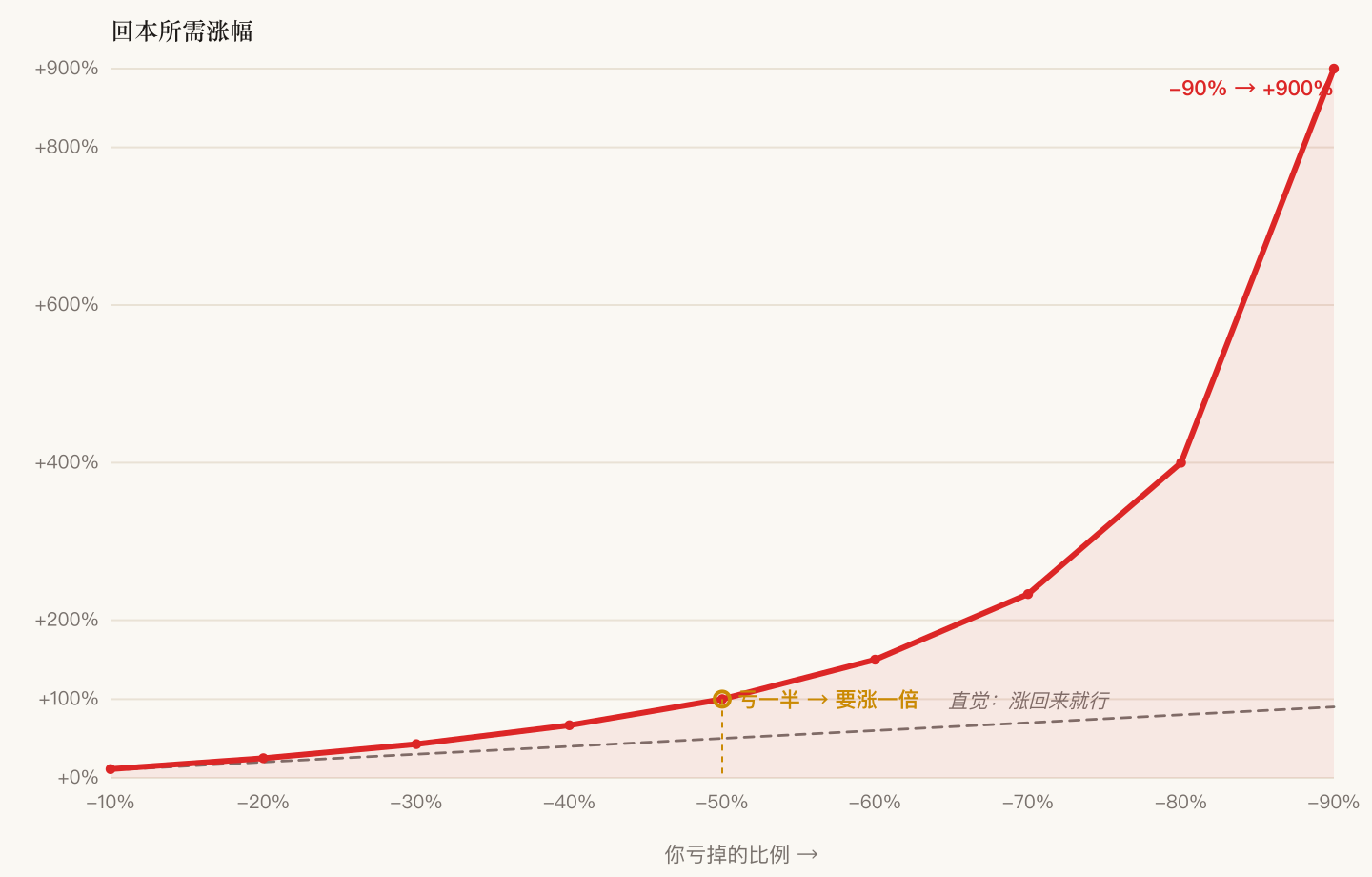
A 50% drop requires a 100% gain to break even. That is why a gamble with a positive average can, with probability 1, wipe out a single player — provided the stake is large enough and the downside path is deep enough.
Arithmetic expectation positive, geometric growth negative — both can hold at once. This is the ergodicity trap: a game that pays viewed sideways (across many players) can be lethal viewed vertically (a single player across time).
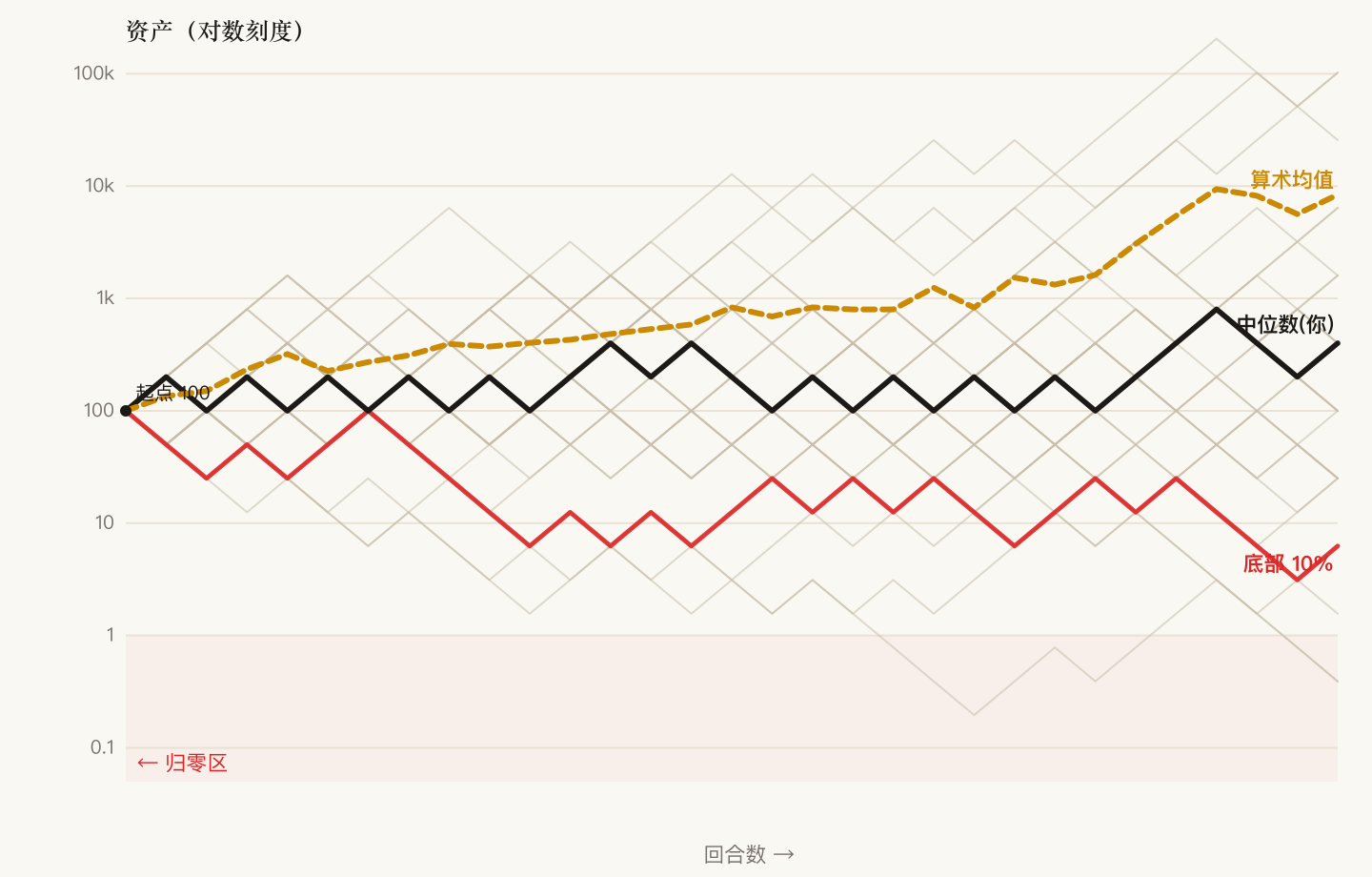
Which surfaces an underappreciated fact: "Is the edge good?" and "How much should I bet?" are two independent questions, and the second one is more lethal. A superb opportunity, sized wrong, ends in bankruptcy; a mediocre opportunity, sized with restraint, compounds you alive. What determines your fate is never what you got right — it is how big you bet.
Kelly gives you a ceiling, not a target
So how much should you bet? There is a famous Kelly formula that computes the bet fraction that maximizes long-run growth. It sounds like the holy grail — but it carries a fatal prerequisite: it assumes you know the true win probability and payoff exactly, without error.
You don't. Nobody does. The win probability in your hand is an estimate, and usually an optimistic one.
And Kelly is extremely sensitive to overestimation: overstate the edge by a little, and the formula immediately pushes you into overbetting. Genuine professionals therefore never bet full Kelly; they bet half, or less — voluntarily giving up some growth rate in exchange for a cliff-like drop in ruin probability. Earning one notch less is what keeps you at the table.
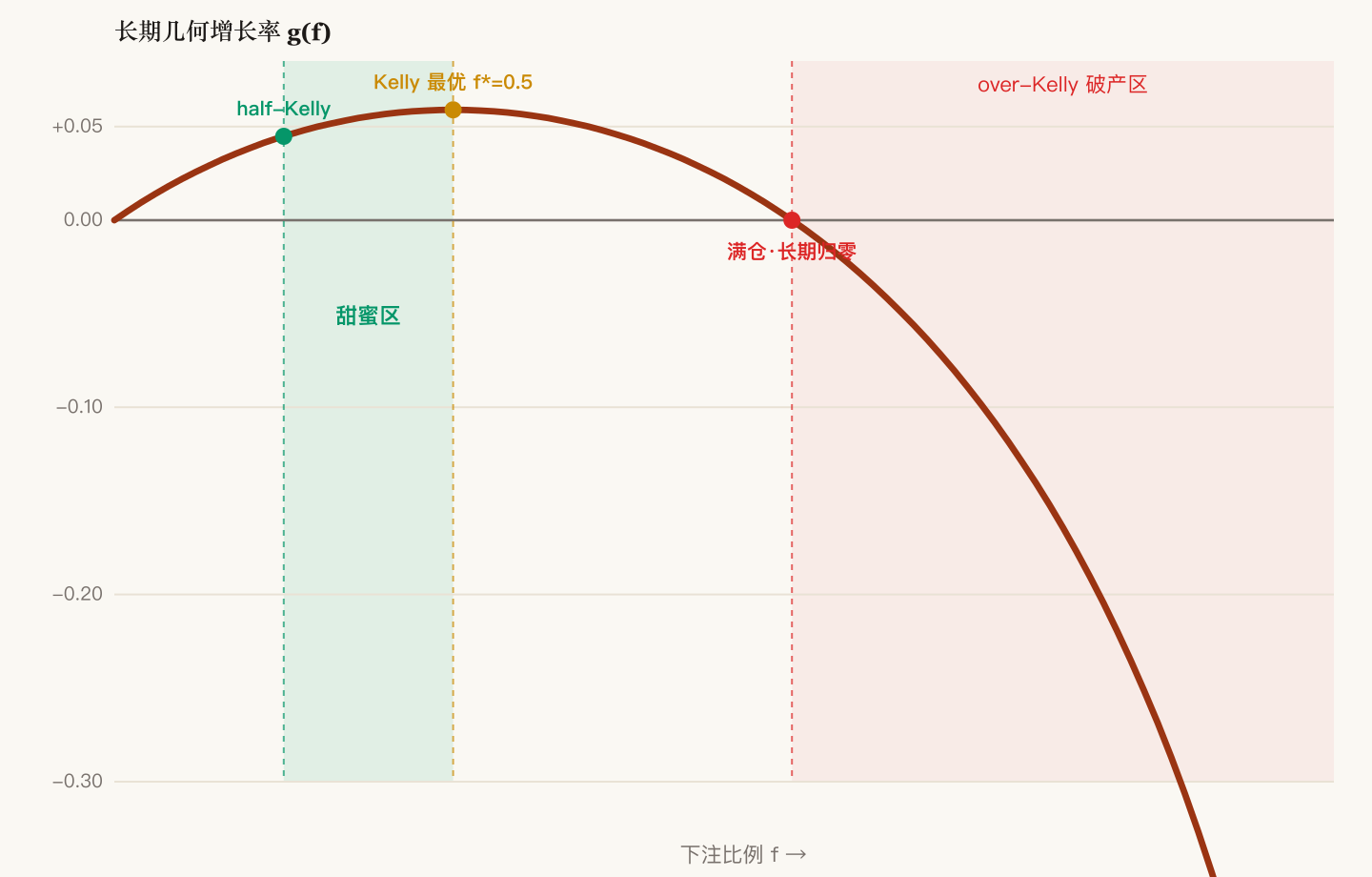
To put it bluntly: almost every real-world blowup is, in essence, over-Kelly, deliberate or not. It's not that direction was wrong — it's that the edge was overestimated, the position was oversized, and along some downside path nobody wanted to think about, geometric compounding did the final accounting.
Take away this one line
Buffett's "Rule No. 1: Never lose money. Rule No. 2: Never forget Rule No. 1" is not a moral homily — it is a hard constraint of geometric compounding: survival is not the precondition of returns; survival is the return. Betting the right direction only lets you win a round; controlling position size lets you keep winning.
The edge decides whether this round is worth betting; position size decides whether you get another one.
The next piece, Investing Mindset, takes on its counterintuitive sibling: why "being right" is worth far less over the long run than you think — and whether what you earned was truly skill, or luck you mistook for skill.
RELATED
FOLLOW
New posts land here first. Subscribe via RSS: /feed.xml
AUTHOR
Tianli Zeng
Hydraulic engineer. I write about AI methodology, daily investment reviews, and engineering practice.