WRITING
Same Blade: Surgery in US Stocks, Bare-Handed in A-Shares

A strategy that reliably makes money in the US market can flip to reliably losing money when moved to the A-share market — and it has nothing to do with your skill level.
A lot of people can't wrap their heads around this. Same logic, same person, same discipline — swap the market and it falls apart. So they pin it on "I'm just not cut out for A-shares" or "A-shares are too much of a casino."
Wrong. The problem isn't you. The problem is that the meal your strategy needs to eat simply can't be cooked in the A-share kitchen.
Let me put the most counterintuitive line right up front: whether a strategy works isn't decided by the strategy itself — it's decided by the market's microstructure. A strategy is fundamentally about harvesting a specific inefficiency — a place where others mispriced something, a risk they didn't want to carry, chips they were desperate to unload. That inefficiency is the meal you eat. So the real question is never "am I good enough" — it's: can this market feed the inefficiency my strategy needs? If yes, you have edge; if no, every move you make is textbook correct and the P&L is still negative. This isn't a question of better or worse. It's a question of whether that dish is on the menu.
Dissecting "selling volatility" as a specimen
One thing I ran for a long stretch can be crudely summarized as: systematically selling volatility to collect the risk premium others pay for peace of mind. In plain English — there's always someone willing to pay for insurance; you be the one who sells it, and you pocket the premium.
For this idea to actually run, it needs a full stack of "infrastructure": a deep enough options market, a wide enough universe of underlyings, tight enough bid-ask spreads, and most critically — a hedging leg you can buy back protection with when things go wrong.
Drop it into the two markets separately and watch how structural differences dictate life or death:
| What your strategy needs | Can US markets feed it | Can A-shares feed it |
|---|---|---|
| Deep options market | Full universe, thick liquidity | Few underlyings, shallow market |
| Tight bid-ask spreads | Low friction | Wide spreads, every trade takes a bite |
| Hedging leg you can buy back | Off-the-shelf toolkit | Basically no such shelf |
| Dominant force | Institutions + passive flows | Retail-dominated flow |
| Exit and shorting | Delisting is normal, shorting is easy | T+1, price limits, shells still have value |
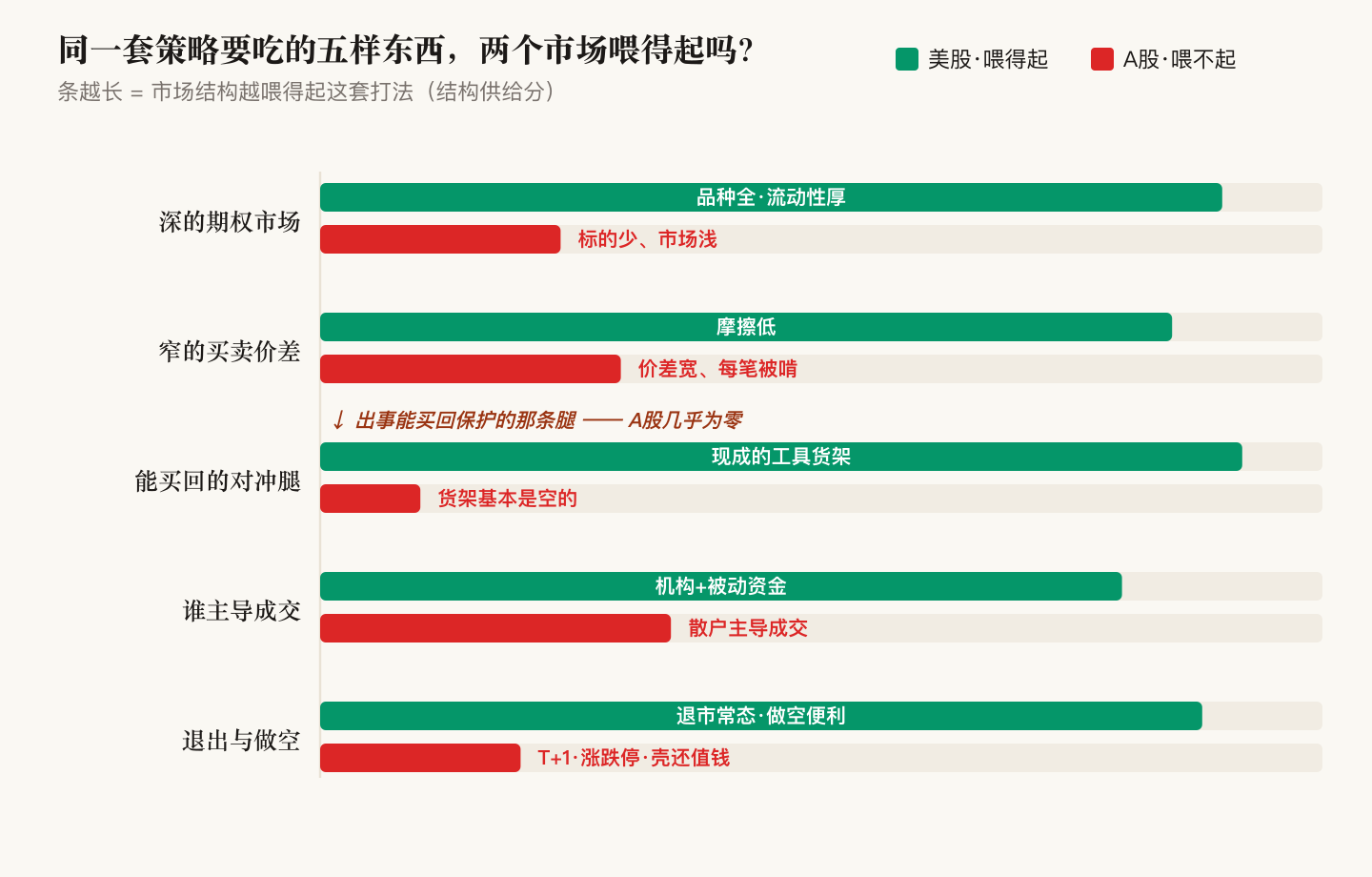
See it? In the US, you're operating on a fully-fitted construction site: you can hedge, you can leg into positions, you can scale — you can slice risk into thin strips and manage it.
In A-shares, the same set of moves — because the hedging leg is missing, the spreads are wide, and the universe is narrow — degenerates into "selling insurance naked." You still collect the premium, but the moment the left tail arrives, you have no tool to buy protection back. You just sit there and take it. Friction eats a slice of edge upfront, and the left tail can wipe you out in one shot. Structurally, the expected return of this playbook can be negative.
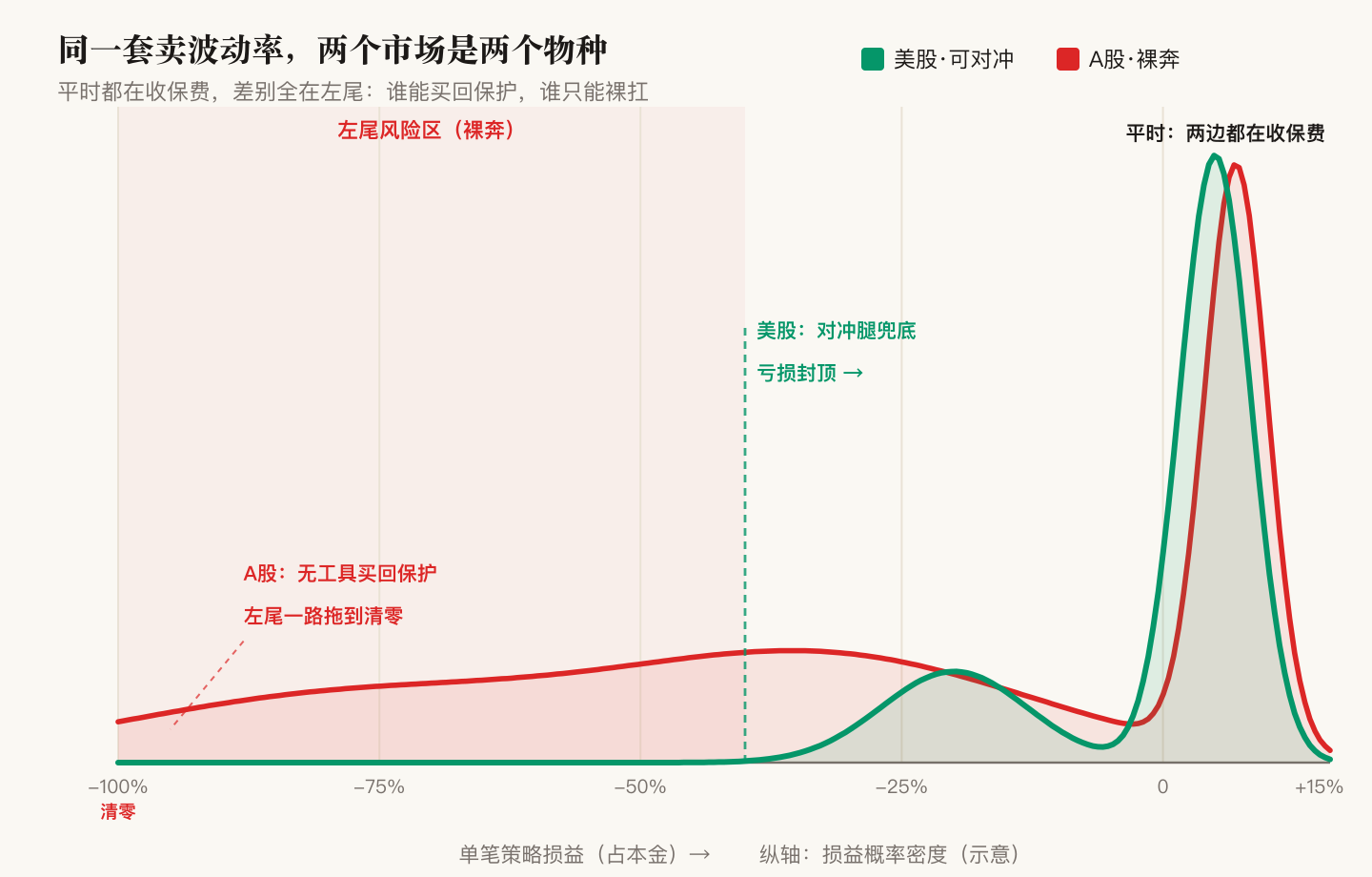
That store doesn't exist in A-shares
The same strategy is two different species in the two markets.
In the US, the way you tame the tail is by buying convexity — spend a little money on deep-out-of-the-money protection that pays off explosively when things blow up, and it carries you through the black swan. It's a business you can transact any time you want.
In A-shares, that store doesn't exist.
So what do you do? Here is the one line from this whole piece I most want you to remember:
Cash isn't "I have no view." Cash is the only put option you can buy in the A-share market.
When a market's hedging shelves are empty, cutting position size and holding cash stops being "timid" or "missing the rally" — it becomes the only protective put you can actually purchase. What it "pays off" in a crash is the principal you didn't lose and the dry powder you can redeploy. In the US market it's a second-best choice; in A-shares it's often the structural optimum.
A single veto
Abstract it into one general principle:
Market structure holds veto power over any strategy.
No matter how elegant the strategy or how self-consistent the logic — as long as the market's microstructure can't feed the inefficiency it needs (shallow, wide, missing a leg, retail-dominated, policy-as-participant) — the strategy is invalid. Not discounted — vetoed.
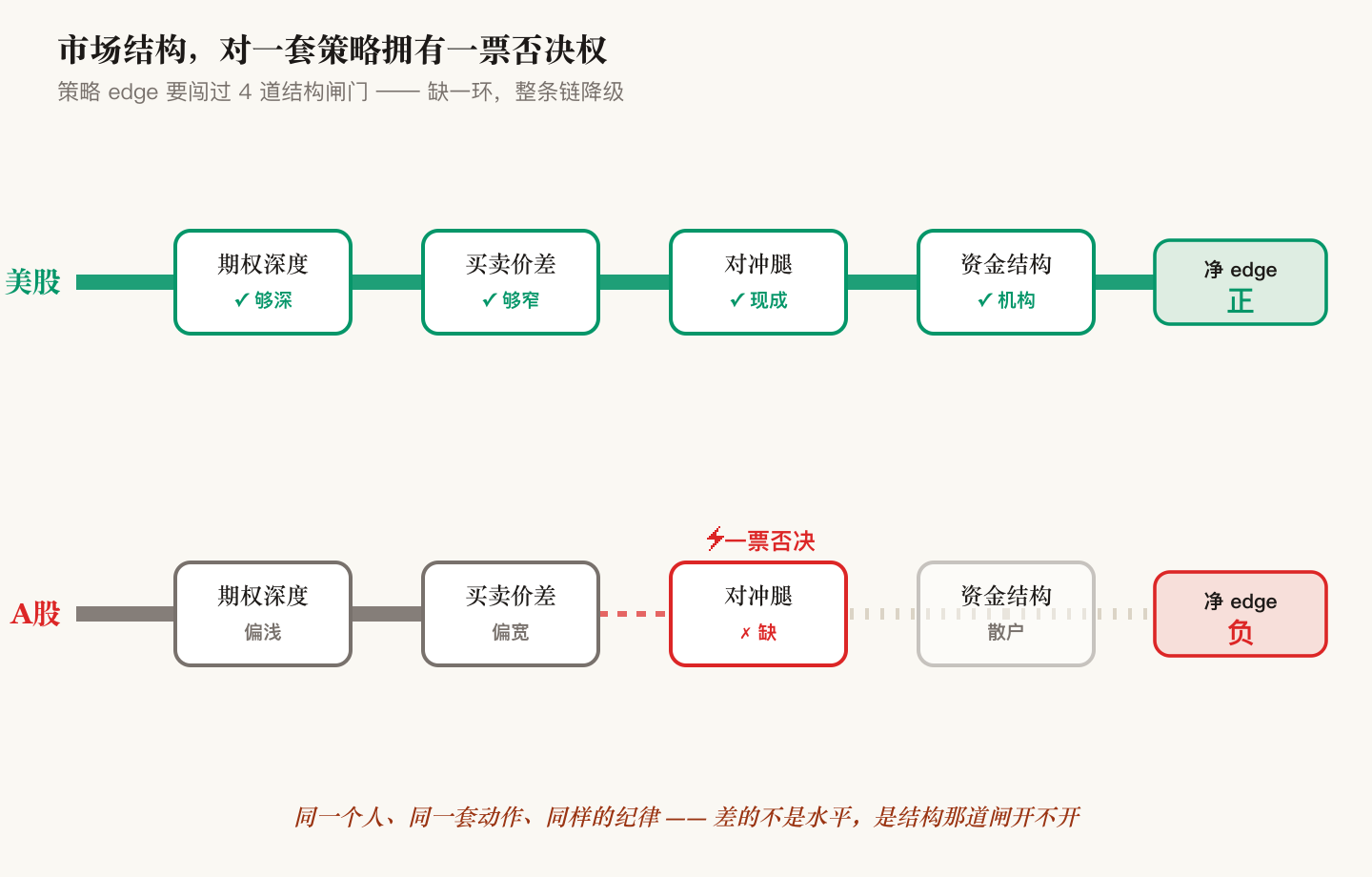
This also explains a common illusion: someone hones their tape-reading on A-shares, sweeps the field for a stretch, and thinks they have edge. What they were actually eating was beta, or the luck of theme rotation — change the structure and the illusion evaporates immediately. Conversely, precision playbooks from the US market get transplanted to A-shares and hit the same wall.
Wrong map — no matter how good your driving skills, you'll only crash faster.
Next time, before you transplant a "battle-tested" playbook into a new market, don't ask "am I good enough" first. Ask this: can this market feed the inefficiency my strategy needs to eat?
(This piece is part of the "Investment Thinking" series. If you want to know why some people can win for a long stretch while having no edge at all — just borrowing the market's beta and dressing it up as their alpha — see the next piece, Your Profits: Skill, or Luck Placing the Orders for You?)
RELATED
FOLLOW
New posts land here first. Subscribe via RSS: /feed.xml
AUTHOR
Tianli Zeng
Hydraulic engineer. I write about AI methodology, daily investment reviews, and engineering practice.