WRITING
The Same Move Cost Me 1.28 Points Yesterday and Nothing Today

Yesterday I wrote a post scolding myself: to shave a little off a purchase price, I spent 1.28 percentage points of safety cushion. One to 326.
Today I made an almost identical move — same same-day-expiry spread, same deliberate decision to leave one contract unclosed, same overnight exercise.
This time the cushion cost was zero.
The difference is one leg. This post is about that leg, and about something else today that's harder to say out loud: the trades I made by hand lost money, and the account beat the index by nearly half a point.
1. Scoreboard
The Nasdaq-100 fell 0.34% today. My account rose 0.14% — a 0.48 percentage point win.
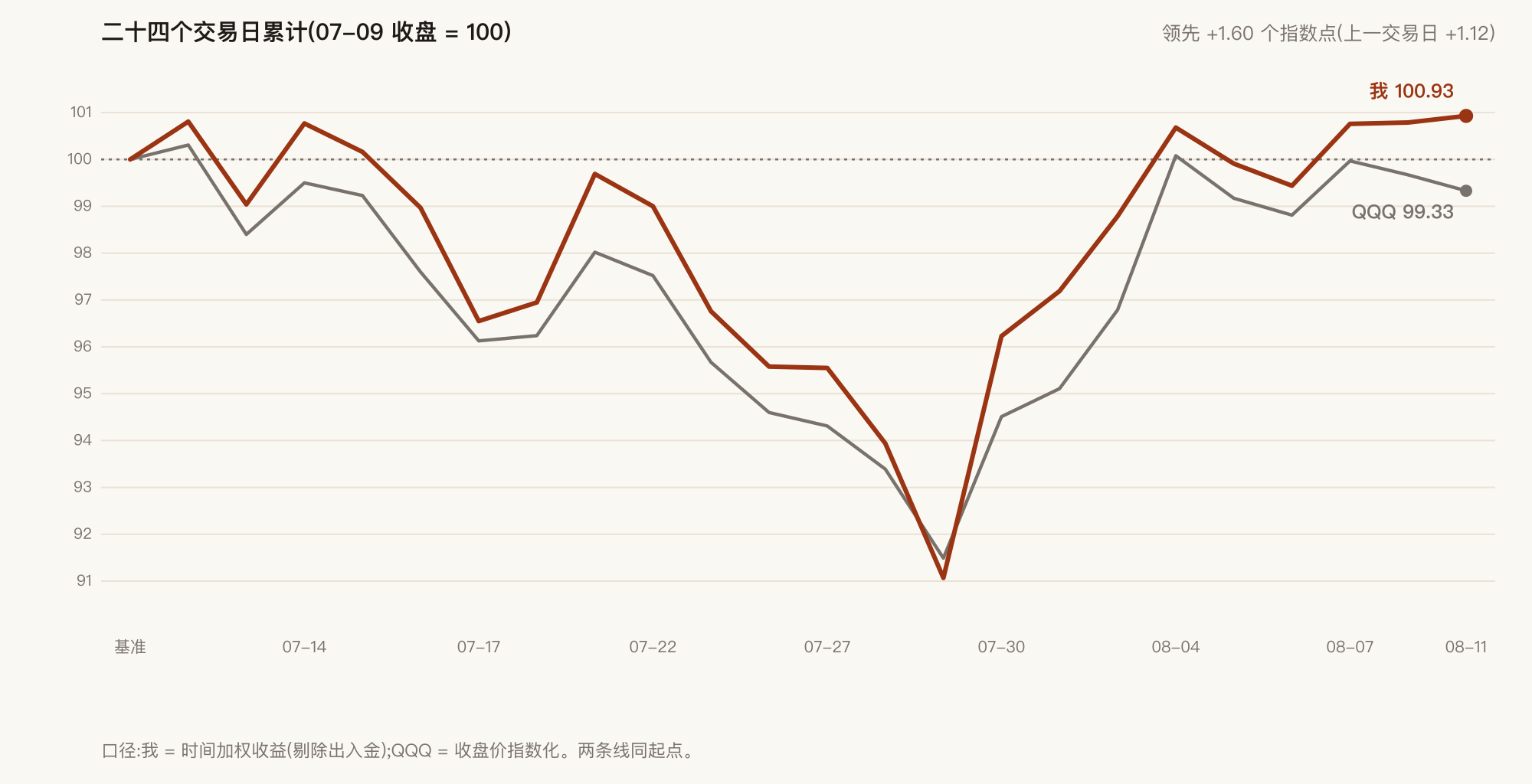
"Me" here is time-weighted return, with deposits and withdrawals stripped out, leaving only what the positions did. Without that, wiring money in would show up as a gain. That's lying to yourself.
Twenty-four sessions in: me +0.93%, index −0.67%, a lead of 1.60 index points. The prior session it was 1.12; today added 0.48.
But the size of the lead was never the point. What produced it is.
2. Who earned today's 14 basis points
Start with the embarrassing part.
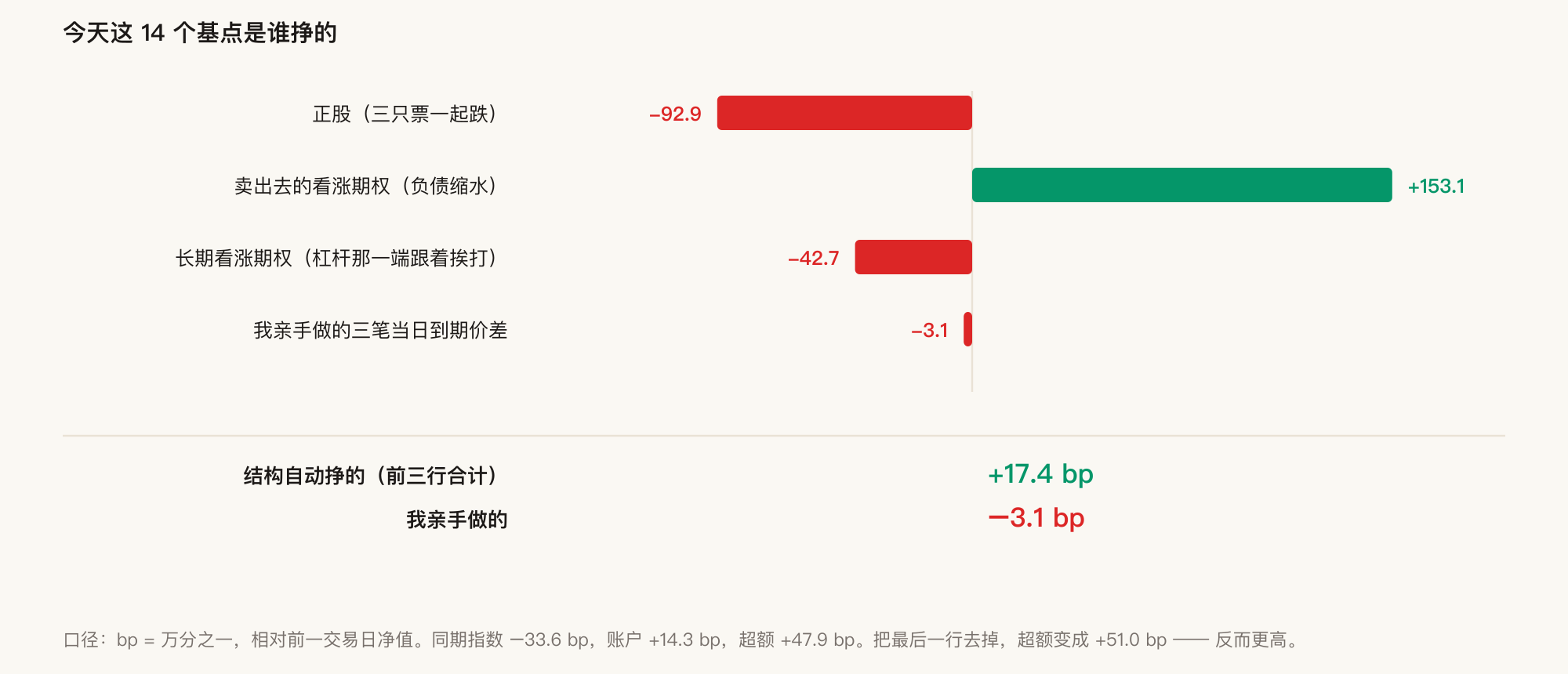
The unit is basis points — one hundredth of a percent — against yesterday's net asset value.
- Stock (all three names fell): −92.9
- Sold calls (liability shrank): +153.1
- Long-dated calls (the leveraged end taking its beating): −42.7
- The three same-day spreads I traded by hand: −3.1
The first three lines are the structure moving on its own: +17.4 basis points together. The fourth line is the part where I actually made a decision today: −3.1 basis points.
Drop that last line and the excess goes from +47.9 to +51.0 basis points — higher, not lower.
Last Friday I wrote exactly the opposite sentence: all of that day's excess came from one directional trade, and stripping it out left the core strategy behind. Today is the other face of the coin: the directional bet lost, and the account still beat the index.
I'm not going to spin this as "the structure is great." It says one thing only: neither day's result came from my judgment — one was luck, one was the structure absorbing it. What repeats is the structure, not the call.
One aside about that +153.1: it's unusually large today, not because the hedge got stronger, but because Google fell 3.6% and Google happens to be the name I have covered most heavily (section 6). A single-name drop landing on the most-covered name is luck, not design.
3. The same move, two different prices
Now the part actually worth recording.
The shape first. What I trade is a same-day-expiry call spread: buy a call at a lower strike, simultaneously sell one at a higher strike, both expiring that day. If both finish in the money, the pair's value is pinned to the gap between the strikes — a structure whose outcome is boxed in.
Yesterday I left one unclosed and let it exercise overnight. Today I did too.
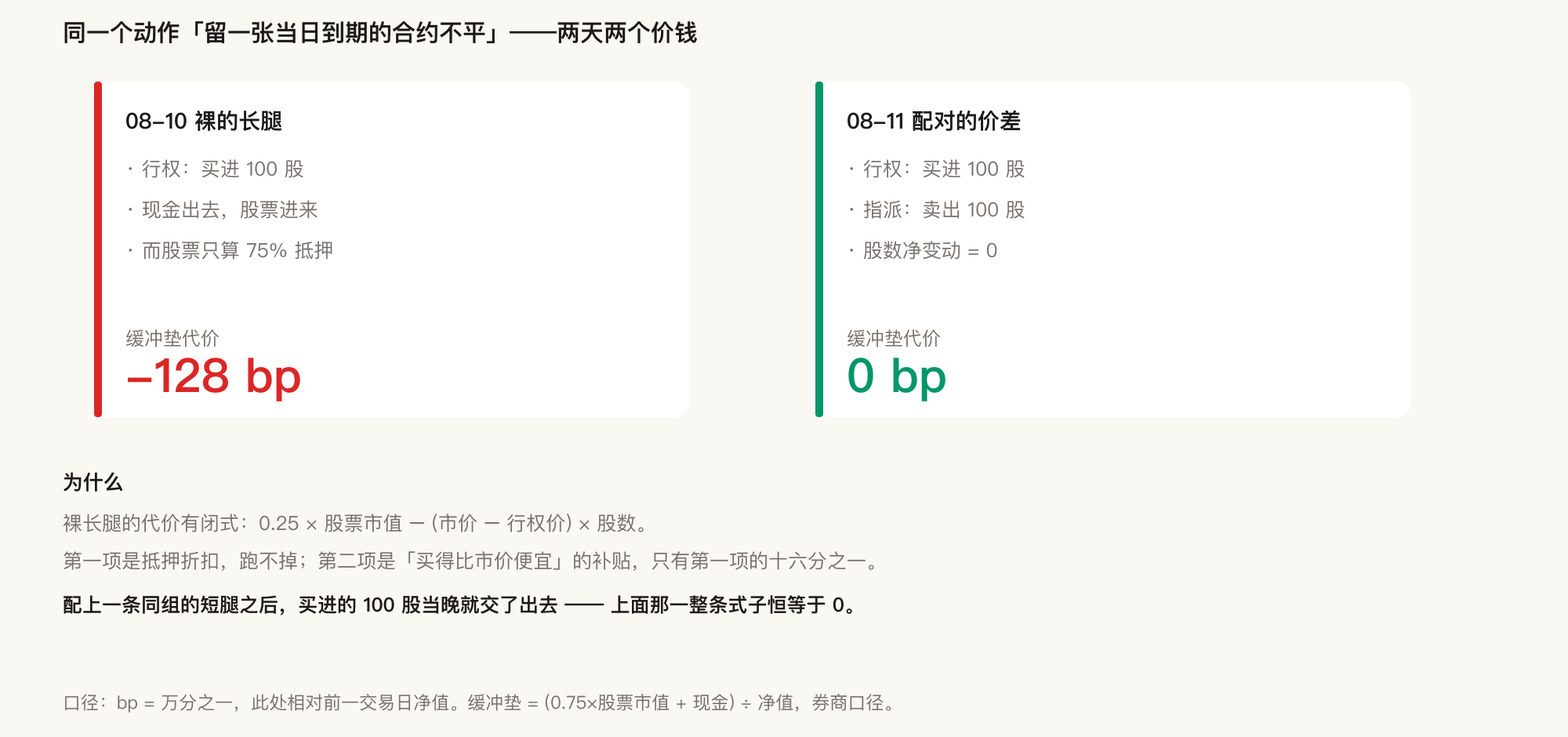
Yesterday what I left was a bare leg. Only the long call. Exercising it means paying cash and receiving 100 shares. Cash out, stock in.
The problem is how the broker sees those two things. When it computes how much room you have left, cash counts at 100% and stock only at 75% — the other 25% is the broker's haircut. So "cash into stock" shrinks your room all by itself.
There's a closed form:
Cost of taking delivery = 0.25 × stock market value − (spot − strike) × shares
The first term is the haircut; unavoidable. The second is the rebate for buying below market — it sounds like an offset, but it's one sixteenth of the first term. Net: −128 basis points.
Today what I left was a complete spread. The long leg exercises and buys 100 shares; the short leg of the same pair is assigned and sells 100 shares. In and out, net share change zero.
In that formula, "stock market value" is zero and "shares" is zero. The whole expression is identically 0.
Same decision, same structure, same "leave one unclosed" move — and the cost went from 128 basis points to nothing. The only difference is whether there was a paired short leg.
I've already written this into my own rule sheet: if you're leaving something to settle, leave a complete spread; never a bare leg. It requires no market judgment and no timing — just counting legs before you send the order.
4. What actually happened to yesterday's decision
Having criticized myself, I owe the outcome too.
The 100 shares that came in from yesterday's exercise were sold before the open this morning. The effective purchase price was "strike + net cost of the spread"; the sale price was 0.37% above it. Scaled to the whole account, +2.0 basis points.
Yesterday I recorded that as 0.39 basis points — but that was the mark-to-market at yesterday's close, not the final result. The actual exit came from an overnight gap up, and the outcome was five times better than what I recorded at the time.
Same on the cushion side. Selling those 100 shares = converting stock back into cash = the exact inverse of yesterday's move, worth +138 basis points today, slightly more than the 128 it cost.
So the complete accounting: the round trip made 2 basis points, and the cushion netted +10.
Does yesterday's criticism still stand? Yes — with one word changed.
What stands: below my own safety line, I used survival room to take on an overnight directional exposure. That risk was real. A hundred shares naked overnight cuts both ways, and last night's gap could just as easily have gone the other way. An ex-ante objection about proportion doesn't become wrong because the trade paid.
What changes: I wrote "spent 128 basis points," as if it were sunk. In fact it was 128 basis points for one night, refunded the next morning. I got the magnitude right and the duration wrong.
Both sentences belong. Keeping only the harsh one is the same species of dishonesty as keeping only the flattering one.
5. Why the cushion rose on a down day
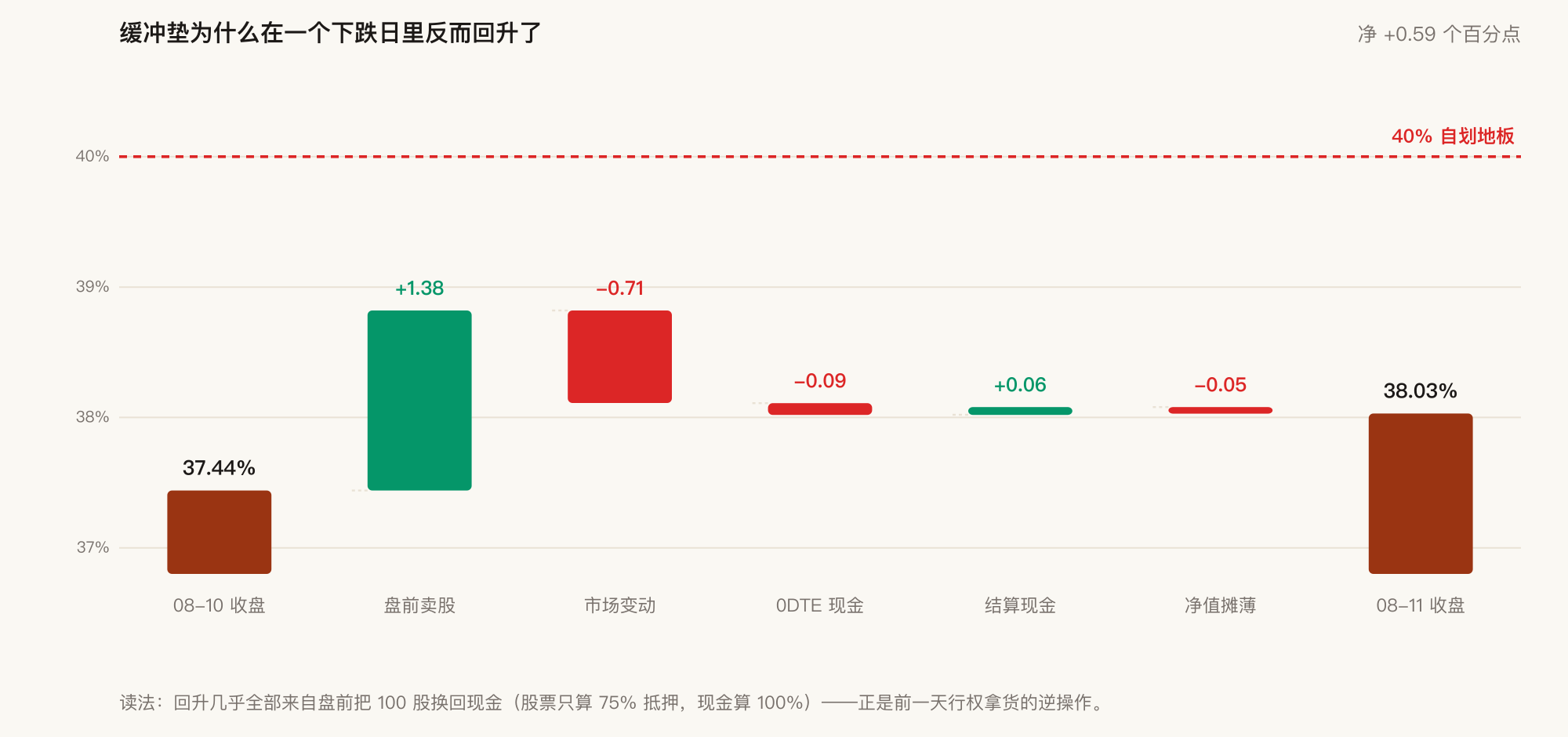
The cushion went from 37.44% to 38.03%, net +0.59 percentage points, in five pieces:
| Step | Change |
|---|---|
| Selling 100 shares back into cash pre-open | +1.38pp |
| Market move (all three names down) | −0.71pp |
| Cash paid for the day's spreads | −0.09pp |
| Net cash from tonight's settlement | +0.06pp |
| Larger net value diluting the denominator | −0.05pp |
| Total | +0.59pp |
A down day, and the cushion went up — with almost all of the rise coming from that one stock sale, not from the tape.
This has to be said plainly, because it is easy to read as "down days are good for me." They are not. The market line is −0.71pp, unfavorable as always. It was covered up by my actively swapping 75%-collateral stock back into 100% cash.
On the same day, the principal cushion on my covered-call book thinned from 9.71% to 9.34%, and the thinnest single position from 7.13% to 6.82% — that is the real direction a down day pushes the positions.
6. How far from the floor
The line I drew for myself is a cushion no lower than 40%. That isn't the broker's requirement — the broker liquidates at zero, which corresponds to another 19.1% decline in the underlying. 40% is my discipline line, not my survival line.
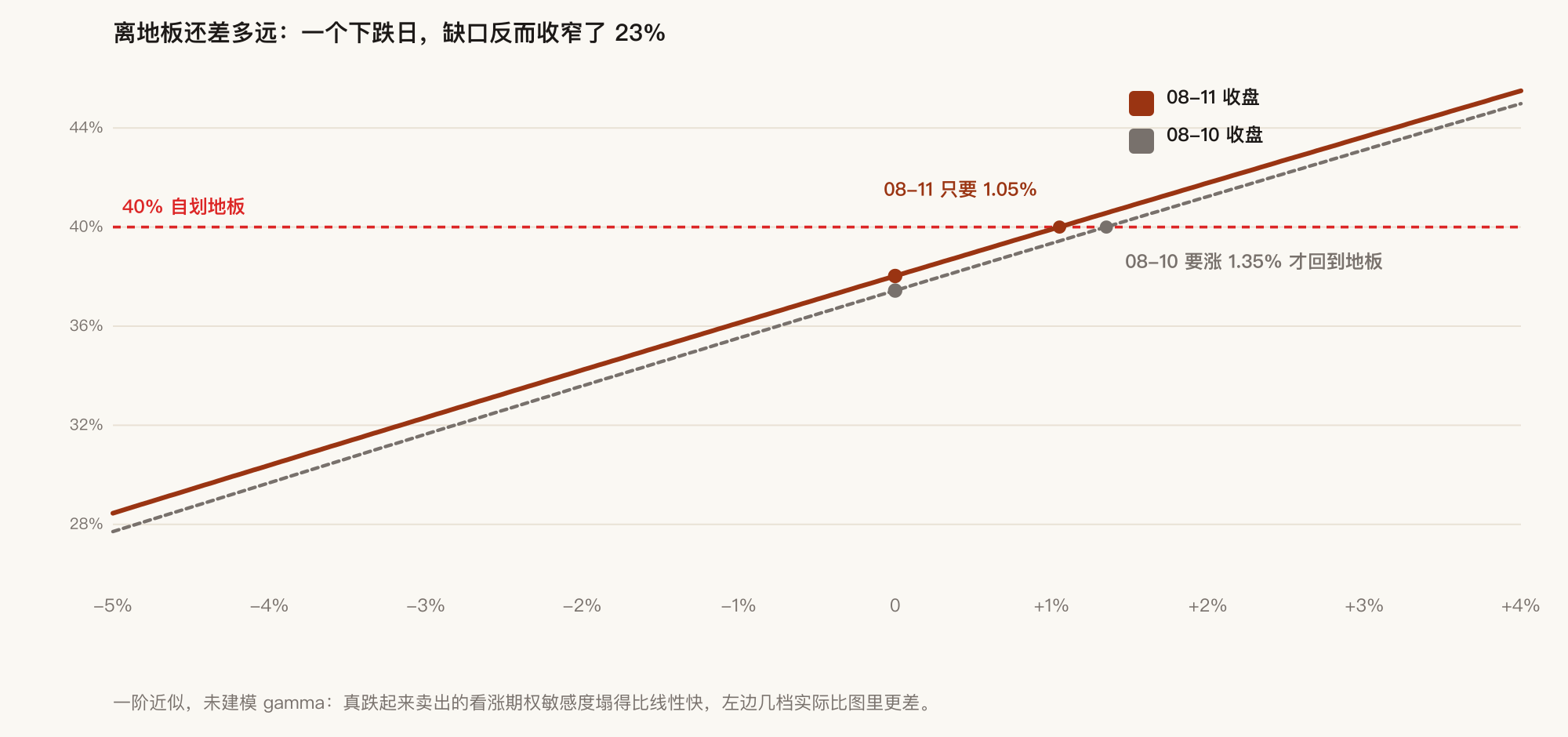
Today closed at 38.03%, 1.97 points short. The self-healing condition tightened from yesterday's +1.35% to +1.05%, and the gap narrowed 23%.
This is the fifth consecutive day below the line. And in those five days I opened same-day spreads three times — 20 contracts, then 10, then 30 today. The size keeps going up.
The recovery condition I wrote for myself is "cushion back above 40% before opening more." All three failed it. "Either change the rule or follow the rule" is a sentence I've been writing since last Friday, and I still haven't chosen. It's in here because a rule broken three times running is no longer a rule.
Today's three trades have a flaw the previous two didn't: same underlying, same expiry, same direction. That isn't three opportunities, it's one bet placed three times. Real diversification means changing the name or changing the date.
7. The only real news today: Google
Google fell 3.61% today, the only big move among my three names. Two things landed the same day:
One, a leadership change at DeepMind. Hassabis stepped down as CEO to become chairman, and veteran researcher Jeff Dean left to start something new.
Two, 2026 capital-spending guidance was raised, from $180–190 billion to $195–205 billion.
The market packaged these into one price reaction, but they are different in kind:
- The leadership change is a signal, not cash flow. Zero direct effect on this year's revenue or profit; what it damages is the narrative premium around "DeepMind is not reproducible." A narrative premium can drop 3% in a day and come back over a product cycle.
- The extra capex is real money. Free cash flow down now, depreciation up later, and the returns are uncertain and distant.
Same template as Intel yesterday: certain near-term cost versus uncertain distant return, and that timing mismatch is the few percent. The difference is that Intel sold shares (dilutive, hits per-share value) while Google is spending its own cash flow (not dilutive). Which makes Google's drop more sentiment-driven than Intel's was.
For my account: the loss on those 100 shares was 95.2% absorbed by the deep-in-the-money call I'd sold against them. Net exposure close to nil.
That is deep-ITM covered writing working exactly as designed — and it's symmetric: on the way up, that same 0.98 sensitivity eats 95% of the gain too. It stood on my side today purely because today was down.
Intel finished +0.19%, recovering part of yesterday's drop on the share offering. Not touching it yesterday was right — handing over the remaining time value at a news-driven low means buying it back more expensively today.
8. What actually matters this week
Not today's 14 basis points, and not those three spreads. Friday, and tomorrow.
Inflation data comes out tomorrow. Today's decline was essentially waiting for it — large-cap tech down, small caps actually up, industrials green: a textbook pre-event repositioning, not a fundamentals move. Today's direction says nothing about tomorrow's. And I am net long with floating-rate debt, so a hot print is a double hit.
Seven sold calls expire Friday, three days out. Six are still in the money; one dropped out of the money today. Letting those six settle means delivering 600 shares and taking in a large amount of cash that pays down debt directly — still the only action this week that materially repairs the cushion and requires no market judgment from me at all.
Beyond that is the expiry wall ten days out: 69 contracts at once. That is the route that pulls the cushion back above the line without my doing anything.
And one new constraint appeared today, harder than the cushion: the number of calls I've sold now exactly equals what the underlying holdings can cover — zero slack. Selling those 100 shares this morning gave back the single contract of slack that yesterday's exercise had created. Sell one more call now and it becomes naked. The cushion is a numerical constraint; this one is structural — numbers can wait for the market to come back, structure doesn't grow on its own.
9. Three notes to myself
One: when you win, be clear about who won. Today's 0.48 points came from the structure; the part I traded by hand was negative. Last Friday was exactly the reverse. Both get called "beating the index," and they are not equally repeatable.
Two: the cost of a move can live entirely in a detail you didn't count. A bare leg and a complete spread look nearly identical on the order screen, and they differ by 128 basis points. That's not a judgment call, it's a checklist item — counting legs before sending the order would have caught it.
Three: hold your self-criticism to the same standard of evidence. Yesterday I wrote a cost down as sunk; today it came back. Magnitude and duration are two different things, and getting either wrong is getting it wrong. Admit errors precisely, and correct them precisely too.
All figures come from broker closing snapshots via their raw API, reconciled through my own engine; the residual between position-by-position attribution and the net-asset-value method is 0.00. This post publishes ratios and percentage points only, never dollar balances.
RELATED
FOLLOW
New posts land here first. Subscribe via RSS: /feed.xml
AUTHOR
Tianli Zeng
Hydraulic engineer. I write about AI methodology, daily investment reviews, and engineering practice.