WRITING
Saving $52 Cost Me 1.28 Points of Survival Room

Last Friday I wrote a line: on the day it rallied, I sold off tomorrow's upside.
Today was the mirror of that line. The index fell and my account drifted up. Same positions, same rules — only the direction changed, and the way I won changed completely.
That's the good news. The bad news: on the same day I made a decision that spent 1.28 percentage points of safety cushion to capture fifty-two cents a share.
Numbers first.
1. Scoreboard
The Nasdaq-100 fell 0.30% today. My account rose 0.026% — a 0.33 percentage point win.
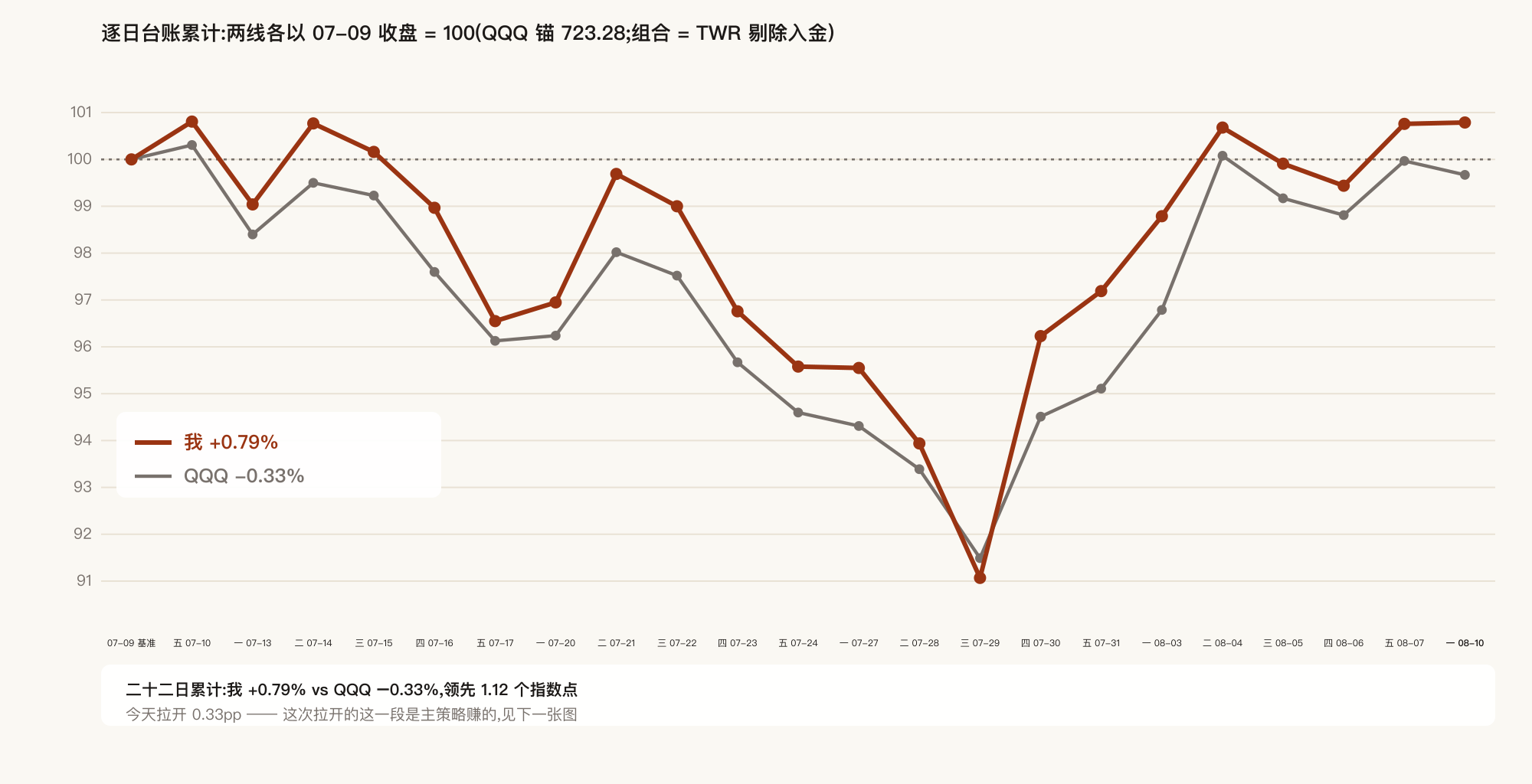
"Me" here is time-weighted return — deposits and withdrawals stripped out, leaving only what the positions actually did. Without that adjustment, wiring money in would show up as a gain. That's lying to yourself.
Twenty-two sessions in: me +0.79%, index −0.33%, a lead of 1.12 index points. The previous session that lead was 0.79 points; today added 0.33.
But the size of the lead was never the point. What produced it is.
Last Friday I led by 0.15 points, and all 0.15 came from a trade my own written rule said I shouldn't take. Strip it out and the core strategy lagged by 0.115 points.
Today is different. Strip out today's directional trade and the account is −0.043% against the index's −0.300% — still a 0.26 point win. The structure earned it.
2. Same machine, two days, opposite directions
My book is a pile of stock plus a pile of call options I've sold. Those sold calls are a liability: when the stock rises they get more expensive and I owe more; when it falls they get cheaper and I owe less.
So the two legs always move against each other. That isn't luck, it's structure.
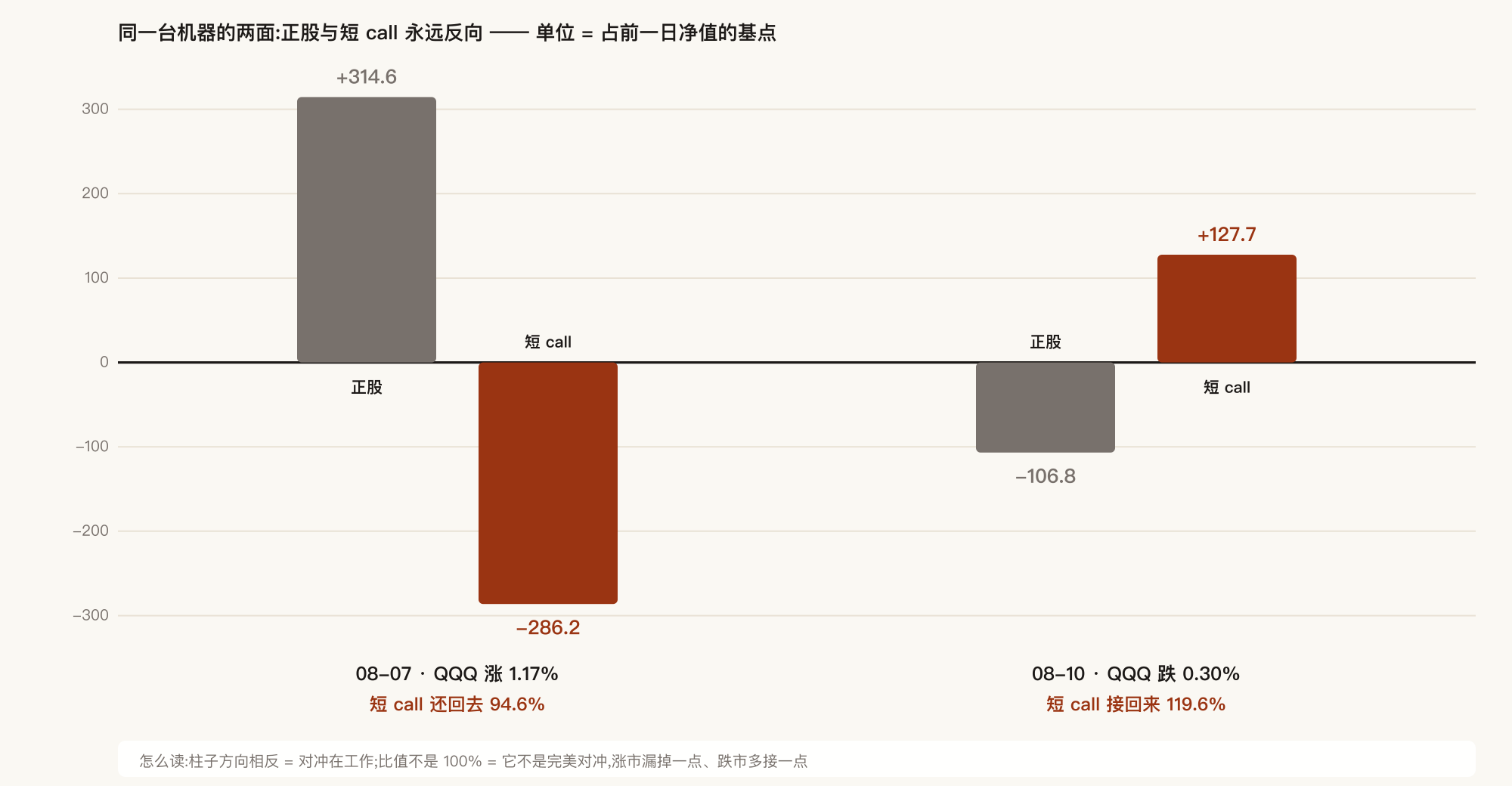
Two days side by side. The unit is basis points — one hundredth of a percent. I don't publish dollar amounts, but the ratios are real.
Friday, index +1.17%: the stock made 314.6 basis points and the sold calls handed back 286.2 — 94.6% returned.
Today, index −0.30%: the stock lost 106.8 basis points and the sold calls made back 127.7 — 119.6% recovered.
One sentence for the whole book: it gives back about 95% on the way up and catches about 120% on the way down.
Some people see "gives back 94.6%" and think loss; they see "catches 119.6%" and think gain. Both reactions are wrong — these are two faces of one thing. I sold the upside for cash on the day I opened. That exchange is done. Every day after is just settlement.
What's actually worth noting is that the second number is above 100%. Why does the down day recover a larger fraction than the up day surrenders?
Because most of what I sold is deep in the money — strikes far below spot. Those contracts have a sensitivity near 1: the stock drops a dollar, they drop nearly a dollar. Meanwhile part of my stock is unhedged (roughly six hundred shares of exposure today), and my long-dated calls fall alongside. Stack those together and on a down day the hedge side outweighs the stock side in absolute terms.
The technical name is negative gamma: my market exposure automatically grows when things fall and shrinks when they rise. Today's drop was only 0.30%, so the effect looks gentle. On July 29th, when the index fell to 661, the same measure was roughly nine times larger.
The asymmetry is the point. A pretty reading on this side says nothing about the other side.
3. The decision I didn't have to make
Two minutes after the open I bought a same-day-expiry call spread: long the 710 strike, short the 722, ten contracts, net cost 10.35 each.
Maximum value of that structure is 12.00 (the gap between strikes), so the most it can make is 1.65.
At 3:45pm I offered to close nine of them at 11.64. Sixty seconds, no fill. I cut to 11.27. It filled at 3:46 — actually at 11.31, four cents better than my own offer.
Realized on those nine: (11.31 − 10.35) × 9 × 100 = $864.
I'd grade that execution as passing. The price-cutting step especially — last Friday in the same situation I offered 6.65, got no fill, and then raised to 6.75 before walking it all the way down to 6.43. Today the very first adjustment went the right way.
The problem is the tenth contract.
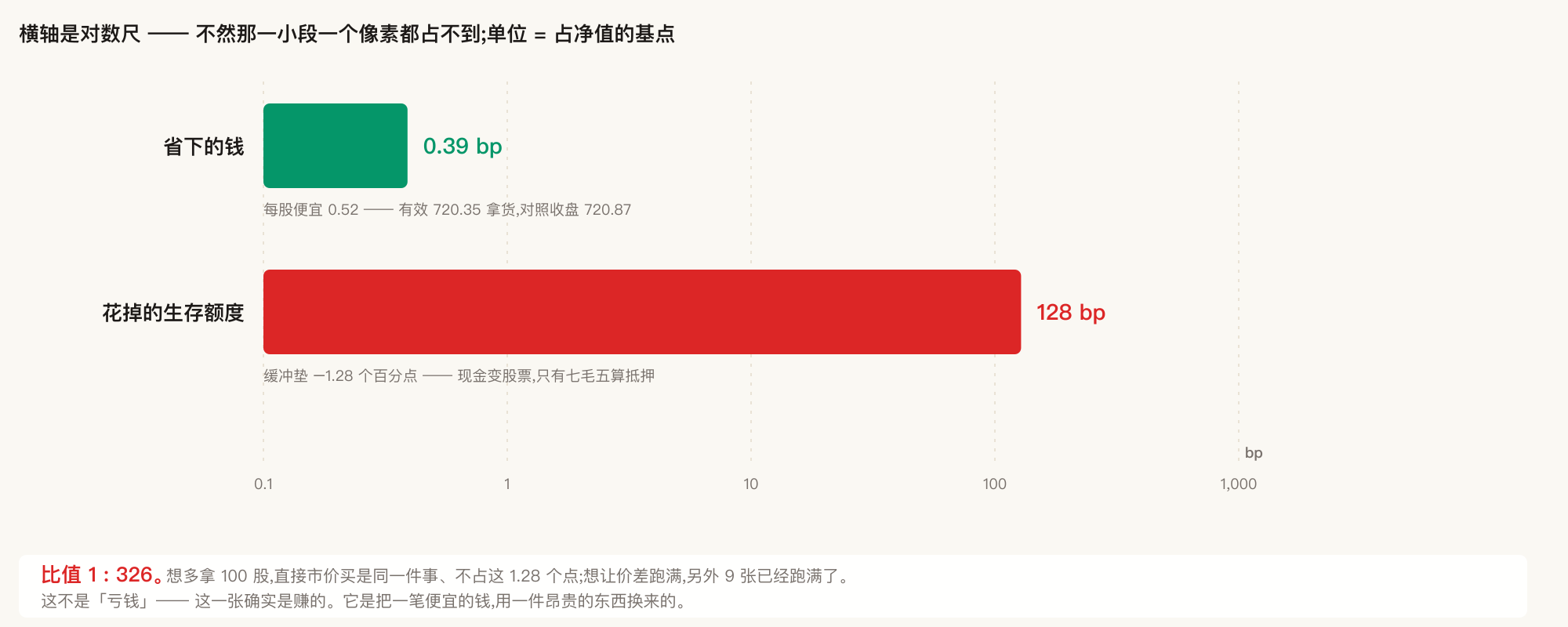
I wrote 9 on the order, not 10. That was deliberate: leave one open, let it exercise overnight, and effectively buy 100 shares of the index ETF at "strike 710 + net cost 10.35 = 720.35 a share." The close was 720.87. Fifty-two cents a share cheaper. $52 total.
Sounds free. It has a price tag, and I didn't compute it at the time.
4. Why taking delivery is so expensive
To explain the 1.28 points, I have to explain how the broker measures "how much room is left."
The broker doesn't care what I've made. It cares how far I am from forced liquidation if things crash. For an account like mine the formula reduces to:
Cushion = (0.75 × stock market value + cash) ÷ net liquidation value
Stock counts at only 75% as collateral — the other 25% is the broker's haircut. Cash counts at 100%.
Now watch what exercising does:
- $71,000 of cash goes out (100 shares × strike 710) → numerator drops by 71,000
- $72,087 of stock comes in (100 shares × close 720.87) → numerator gains only 0.75 × 72,087 = 54,065
Net effect on the numerator: −16,935.
As a formula:
Cost of taking delivery = 0.25 × stock market value − (spot − strike) × shares
= 0.25 × 72,087 − 10.87 × 100 = 18,022 − 1,087 = 16,935
The first term is the haircut — unavoidable. The second is the rebate for buying below market, exactly that $1,087 — but it's one sixteenth of the first term.
In cushion terms that's 1.28 percentage points. The $52 I saved converts to 0.0039 percentage points.
One to 326.
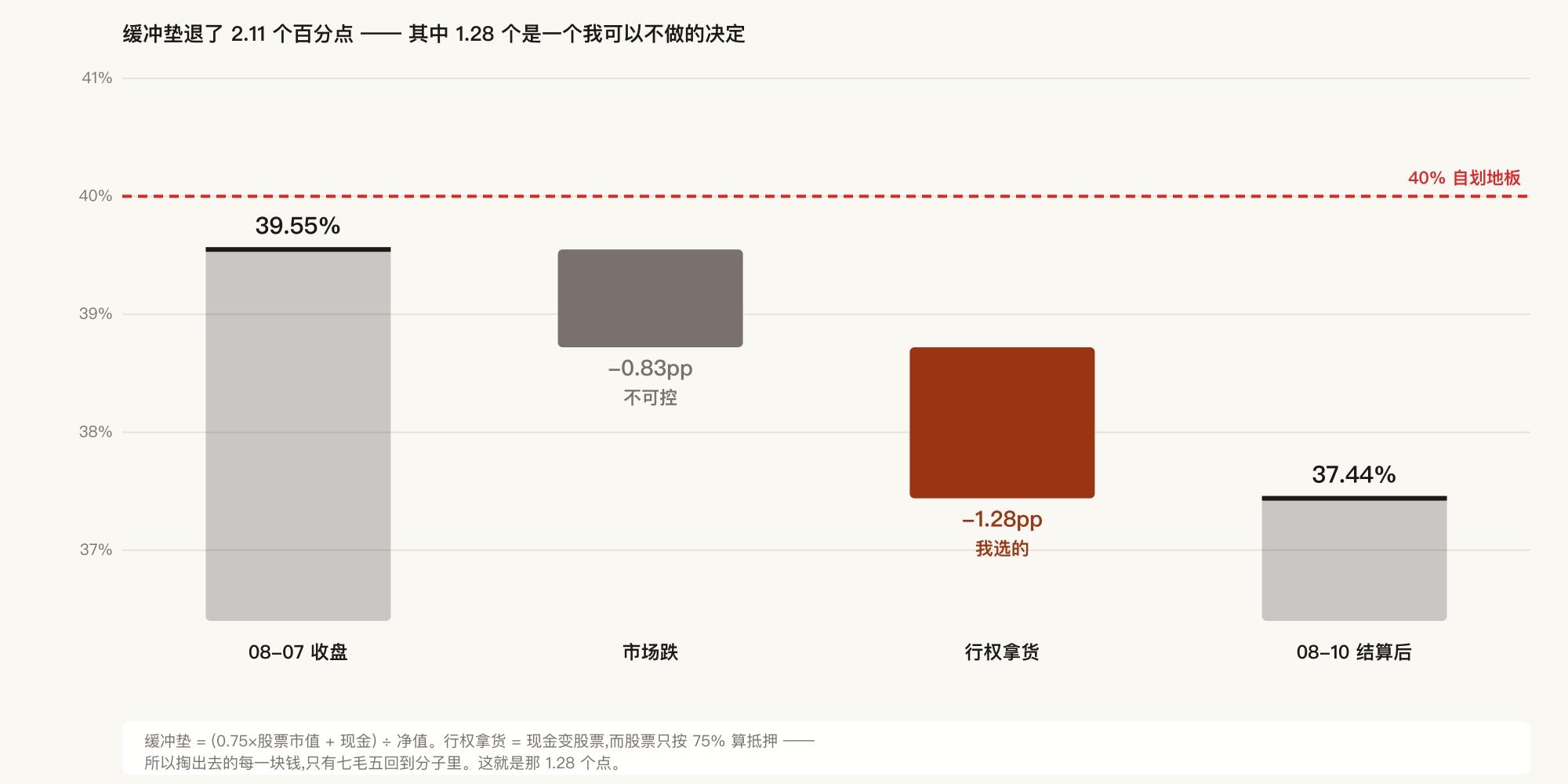
This chart splits today's cushion decline into two pieces. Total decline: 2.11 percentage points.
- Market decline: −0.83 points — not controllable, that's just the tape.
- Taking delivery: −1.28 points — that piece I chose.
There's a second layer of cost too. That $71,000 wasn't idle cash sitting in the account; it came out of margin. Last Friday I had just paid debt down by twenty thousand. Today one exercise borrowed back seventy-one — three and a half times as much.
Let me state this carefully, because it's easy to comfort yourself here: that contract did make money. $52, real. It isn't a loss. It is a cheap gain purchased with an expensive thing.
If the goal was to own 100 more shares, buying at market is the same outcome and doesn't cost the 1.28 points (cash-to-stock still takes the haircut, but you don't additionally lay out $71,000 to get a slightly better fill). If the goal was to let the spread run to full value, the other nine already did.
So the decision doesn't map to any objective I can articulate. It was just convenient.
5. Last Friday's "almost back" was an illusion
I set myself a line: cushion never below 40%. That's not the broker's requirement — the broker liquidates at cushion zero, and I'm 18.32% of underlying decline away from that. 40% is my discipline line, not my survival line.
Friday closed at 39.55%, 0.45 points short. I wrote at the time: the index only has to rise 0.24% and it fixes itself.
Today closed (post-settlement) at 37.44%, 2.56 points short. The self-healing condition went from +0.24% back out to +1.35%.
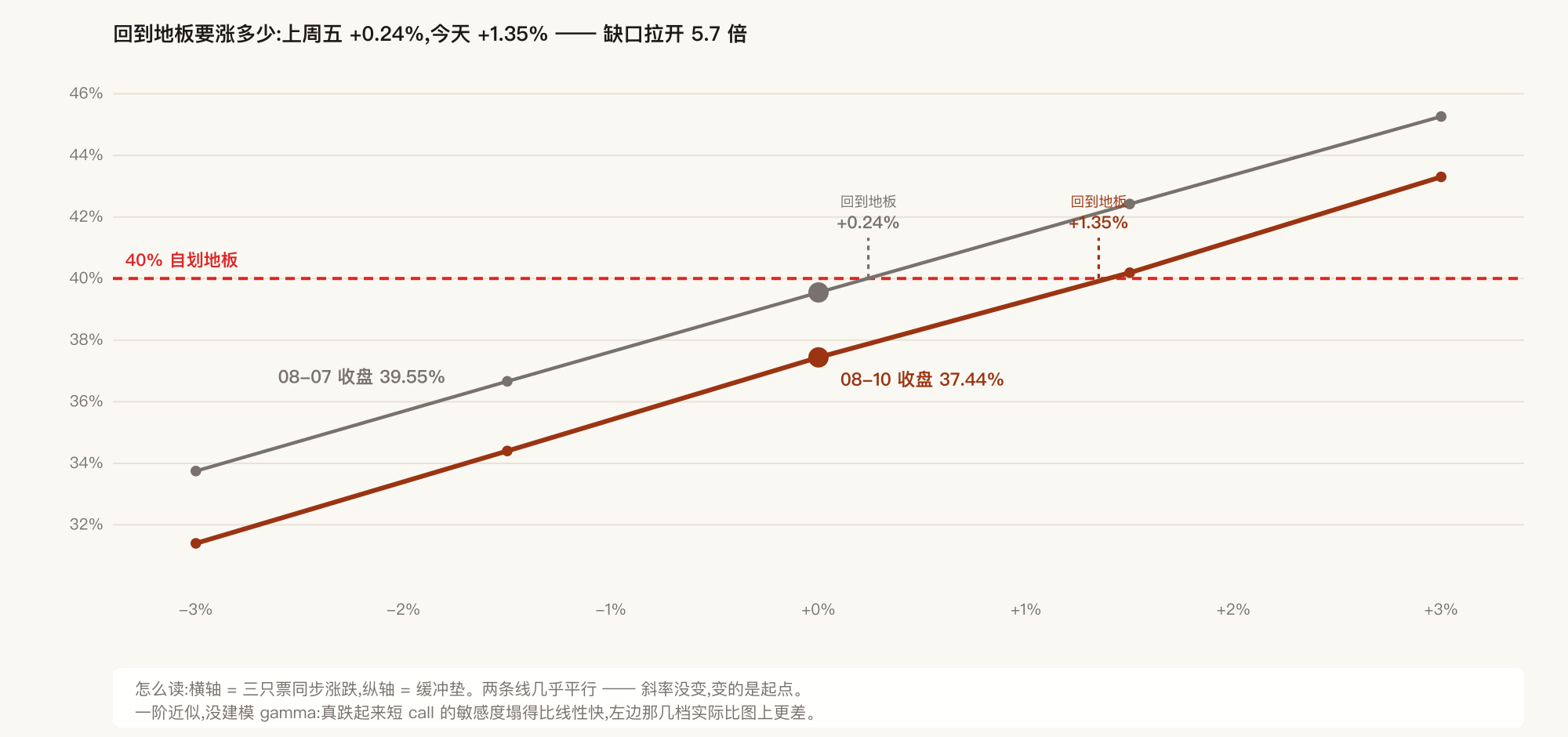
This overlays the "underlying move → cushion" relationship for both days. The two lines are nearly parallel — the slope didn't change, the starting point did.
The gap widened 5.7×. One 0.30% down day plus one exercise wiped out Friday's progress and then some.
The lesson isn't in the number. It's in how I treated that number on Friday. I wrote "only 0.24% away" in a tone that meant "nearly fixed." But that 0.24% was handed to me by a big up day, not earned. What the market gives, it can take back — and it took it back today.
Incidentally, that chart is a first-order approximation; I haven't modeled second-order effects. In a real selloff the sensitivity of those sold calls collapses faster than linear — the left-hand steps are worse in practice than the chart shows.
6. The only real news today
Intel announced a $15 billion underwritten public offering of common stock, proceeds earmarked for "general corporate purposes, which may include capital expenditures and working capital." The stock fell 4.05%.
I hold a thousand shares of Intel and have sold ten calls at the 100 strike expiring August 21.
- Stock: down $4.12 a share
- Sold calls: from 6.58 down to 3.875 — liability shrank
Net, the cushion absorbed 66% of the decline.
Two things worth separating here:
Why issue now? Because the price allowed it. Intel has nearly tripled this year on AI infrastructure demand plus the U.S. government taking a 10% stake. Selling shares at a high to fund fabs is rational capital management, and it isn't bad for long-term fundamentals.
Then why did it fall today? Because the dilution is certain and immediate, while the fab returns are uncertain and distant. That timing mismatch is the 4%.
I didn't touch it. That was right: those calls have 11 days left, and after a 4% drop their sensitivity fell from 0.578 to 0.450 — the position is drifting toward "I can hold this." Acting now means trading away the remaining time value at a news-driven low.
The interesting control group came the same day: Alphabet completed a $25 billion multi-maturity bond offering, and the stock rose 0.68%.
Same week, two giants both raising money for AI capex. One sold equity (dilutive), one sold debt (not). The market only punished the first.
7. What actually matters this week
Not today's $864, and not the $52. Friday.
I have 7 calls expiring August 14, struck at 715 (six) and 720 (one). Today closed at 720.87 — both in the money, with 4 days left.
The 720 contract carries 5.87 of time value, which annualizes to 74%, the richest single line in my book. That number means the market thinks it's closest to the line between assigned and not.
Three paths:
| Choice | Result | Cost |
|---|---|---|
| Let it settle | Deliver 700 shares, take in ~$500k and pay down debt directly | Those 700 shares stop participating in further upside |
| Roll out and up | Keep the shares | Pay two bid-ask spreads; and it puts the 40% line further away |
| Buy back at a loss | Full upside restored | Most expensive time to buy back |
From a cushion standpoint the first is the only path that materially repairs anything — and it requires no market judgment from me.
Beyond that is the August 21 wall: 69 contracts expiring at once, 11 days out. That remains the one route that pulls the cushion back above the line without my doing anything.
8. Three notes to myself
One: when you win, be clear about who won. Today's 0.33 points came from the structure; Friday's 0.15 came from a single directional trade. Both get called "beating the index." They are not the same quality of win.
Two: measure a decision's cost against its benefit on the same ruler. $52 and 1.28 percentage points don't sound like the same kind of quantity, which is exactly why I never ran the comparison. Converted to one unit it's 1 to 326. Different units aren't a reason to skip the comparison — they're a reason to convert first.
Three: progress the market hands you isn't progress. On Friday the cushion went from 37.29% to 39.55%, and I wrote plainly at the time: "the market did that, not me." I wrote it down, and today I still got fooled by it — because I opened another position on top of that base.
There's a gap between writing something down and actually acting like you believe it.
All figures come from broker closing snapshots via their raw API, reconciled through my own engine. The residual between position-by-position attribution and the net-asset-value method is $0.00. This post publishes ratios and percentage points only, never dollar balances.
RELATED
FOLLOW
New posts land here first. Subscribe via RSS: /feed.xml
AUTHOR
Tianli Zeng
Hydraulic engineer. I write about AI methodology, daily investment reviews, and engineering practice.