WRITING
Biggest Red Day of the Run — I Went Shopping for Two Notes (Plus: Intel Earnings Land)

Today the market took its biggest single-day hit of this stretch. QQQ closed at 691.96, down 1.90%; my portfolio's time-weighted return (TWR, deposits excluded) fell 2.26%, trailing by 0.36 points. Unlike the last two no-trade days, I placed three orders today and filled two.
First, why the tape fell — three things stacked up:
- Alphabet's capex shock. The quarter itself was strong — $119.8B revenue, Cloud +82% — but management raised 2026 capex guidance to $195–205B and said 2027 would "increase significantly." Capex doubled to $45B this quarter and free cash flow went negative for the first time in Alphabet's public history. The stock fell 7%, its worst day in 14 months. The market isn't afraid Google is broken; it's afraid of who pays the AI infrastructure bill.
- Tesla missed big — expenses growing faster than revenue, down 14%. The two together erased hundreds of billions in market value and dragged big tech down with them.
- Oil broke $100. Houthi attacks on Saudi tankers in the Red Sea pushed Brent from $94 through $100 in two days, reigniting inflation worries.
Among my names: Netflix closed green at +0.53% against the tape; Intel fell 2.33% during the day, then crushed earnings after the close (section four).
1. The day's P&L, decomposed: the cushion's biggest day yet
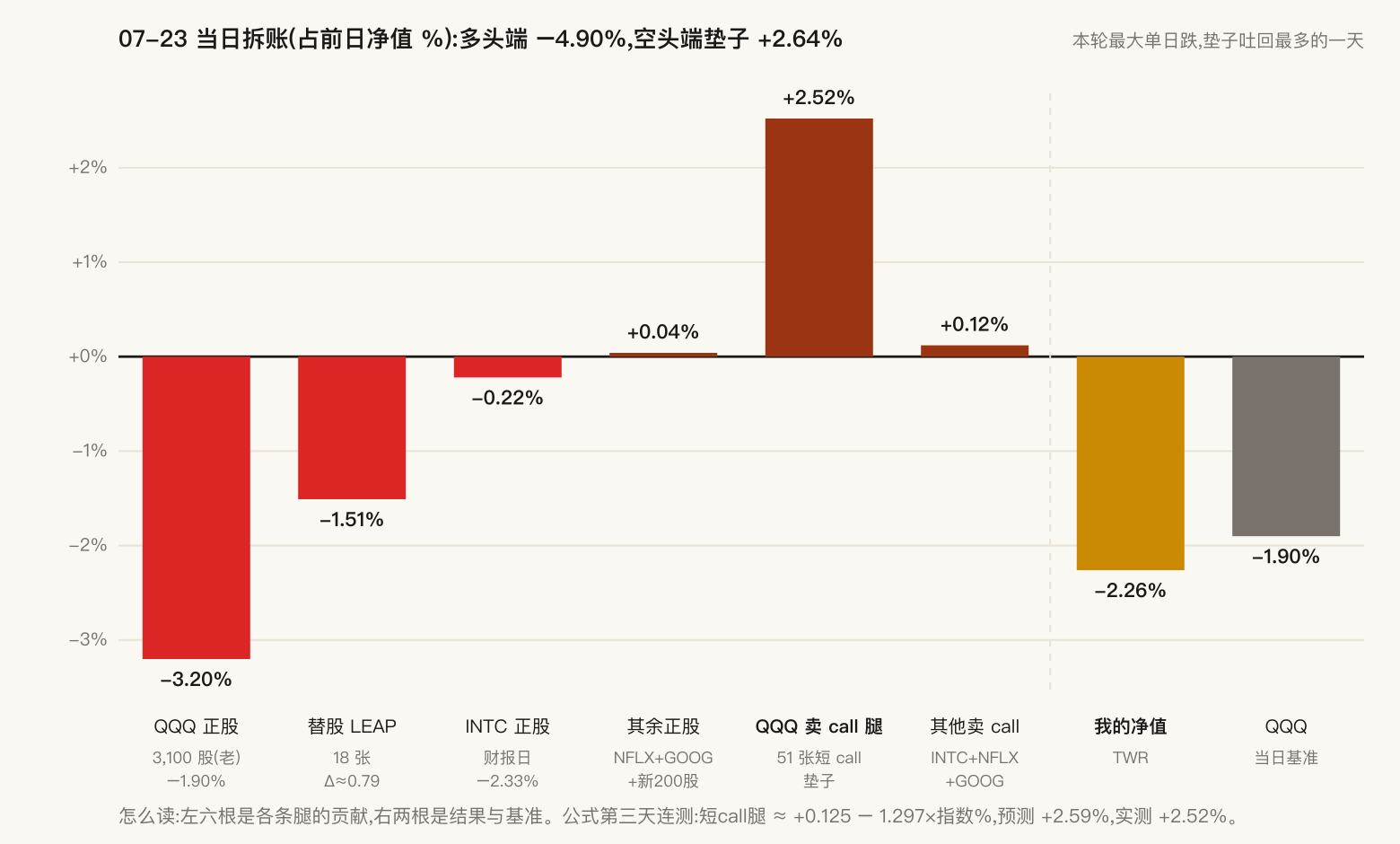
- Long side −4.90%: legacy QQQ shares −3.20%, the stock-replacement LEAPs −1.51%, Intel shares −0.22%. A leveraged long book eats the full red day.
- Short side cushion +2.64%: 51 QQQ short calls gave back +2.52% — the most work the cushion has done in a single day since this book opened — plus +0.12% from the Intel, Netflix, and Google calls.
Net: −2.26%, trailing by 0.36pp. Regular readers can recite the reason: net long > 1x means losing more on down days and winning more on up days, with call premium sanding down the volatility.
Third day testing the straight-line formula: short-call leg ≈ +0.125 − 1.297 × index move. Plug in −1.90% → predicted +2.59%, actual +2.52%, residual 0.07pp. Three days, three regimes (big rally / small dip / big drop) — one first-order line caught them all.
2. Today's real work: shopping in the panic
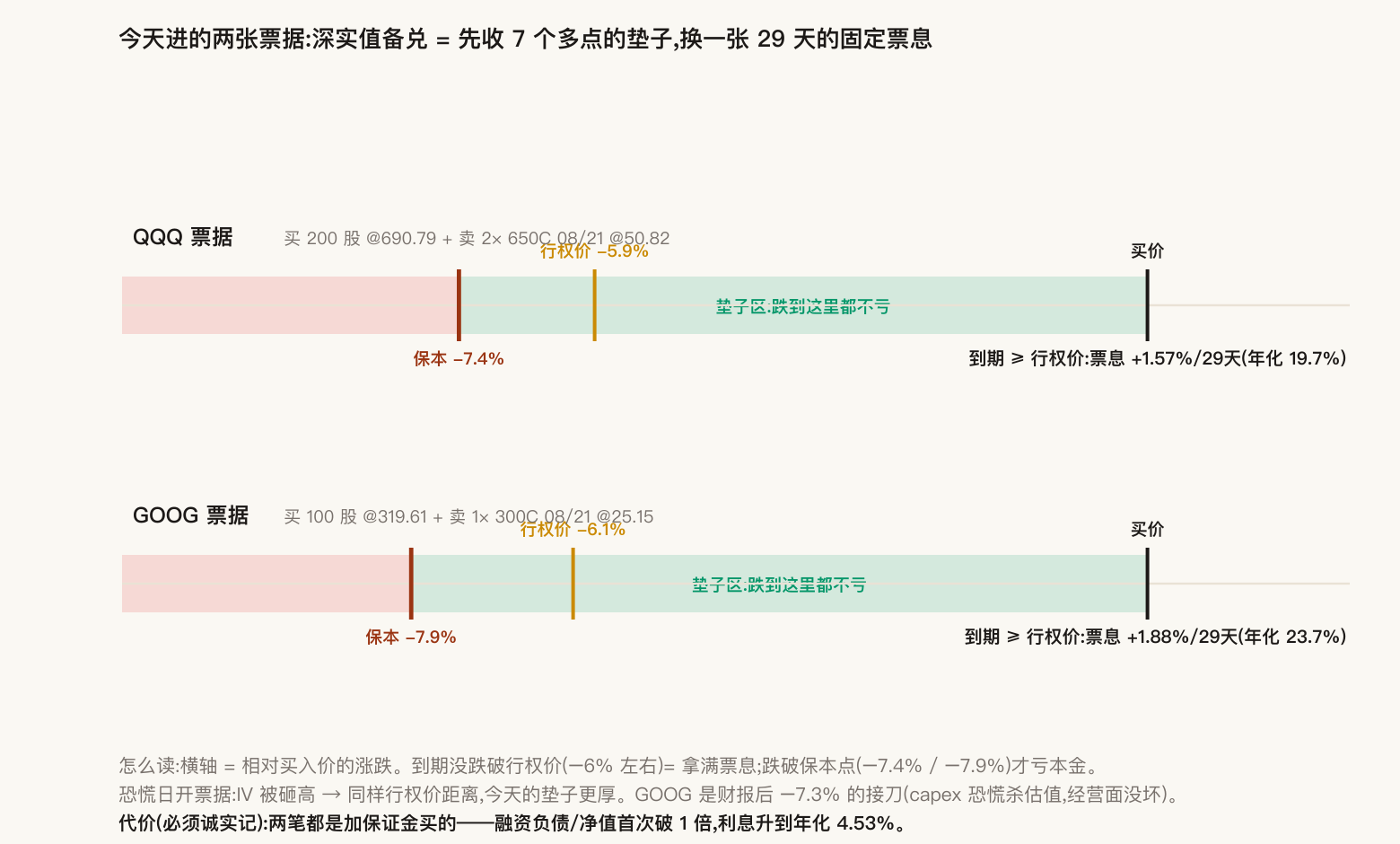
On the red day I bought two "notes" — both deep in-the-money buy-writes (buy stock + sell an ITM call):
- QQQ note: bought 200 shares @690.79 + sold 2× 650 calls (Aug 21) @50.82. Breakeven 639.97 — a 7.4% cushion up front; as long as QQQ doesn't fall below 650 (−5.9%) by expiry, it pays 1.57% in 29 days, ~19.7% annualized.
- GOOG note: bought 100 shares @319.61 + sold 1× 300 call @25.15. Breakeven 294.46, 7.9% cushion; above 300 at expiry (−6.1%) it pays 1.88%, ~23.7% annualized.
Why today? Because panic inflates IV — the same strike distance buys a thicker cushion. Fear is the raw material these notes are made of. The GOOG one goes further: it's catching a knife down 7.3% post-earnings, where the selling was about capex fear compressing the multiple, not a broken business (Cloud +82% says so). I don't know when the knife lands, so I don't catch it bare-handed — I catch it inside a note that doesn't lose until −7.9%.
The honest entry in the ledger: these weren't funded by expiring positions rolling off — they were bought with new margin. Yesterday's post ended with "new notes only get rolled from freed-up capital, no new financing." Today I broke that rule. Margin debt crossed 1x of net worth for the first time, the financing rate is now 4.53% annualized (above the ~3.6% Treasury), and the zero-order distance to a margin call narrowed from 32.5% to 28.3%. I think what I bought was right; how I bought it crossed my own line. Both sentences belong in the same day's review.
3. Scoreboard
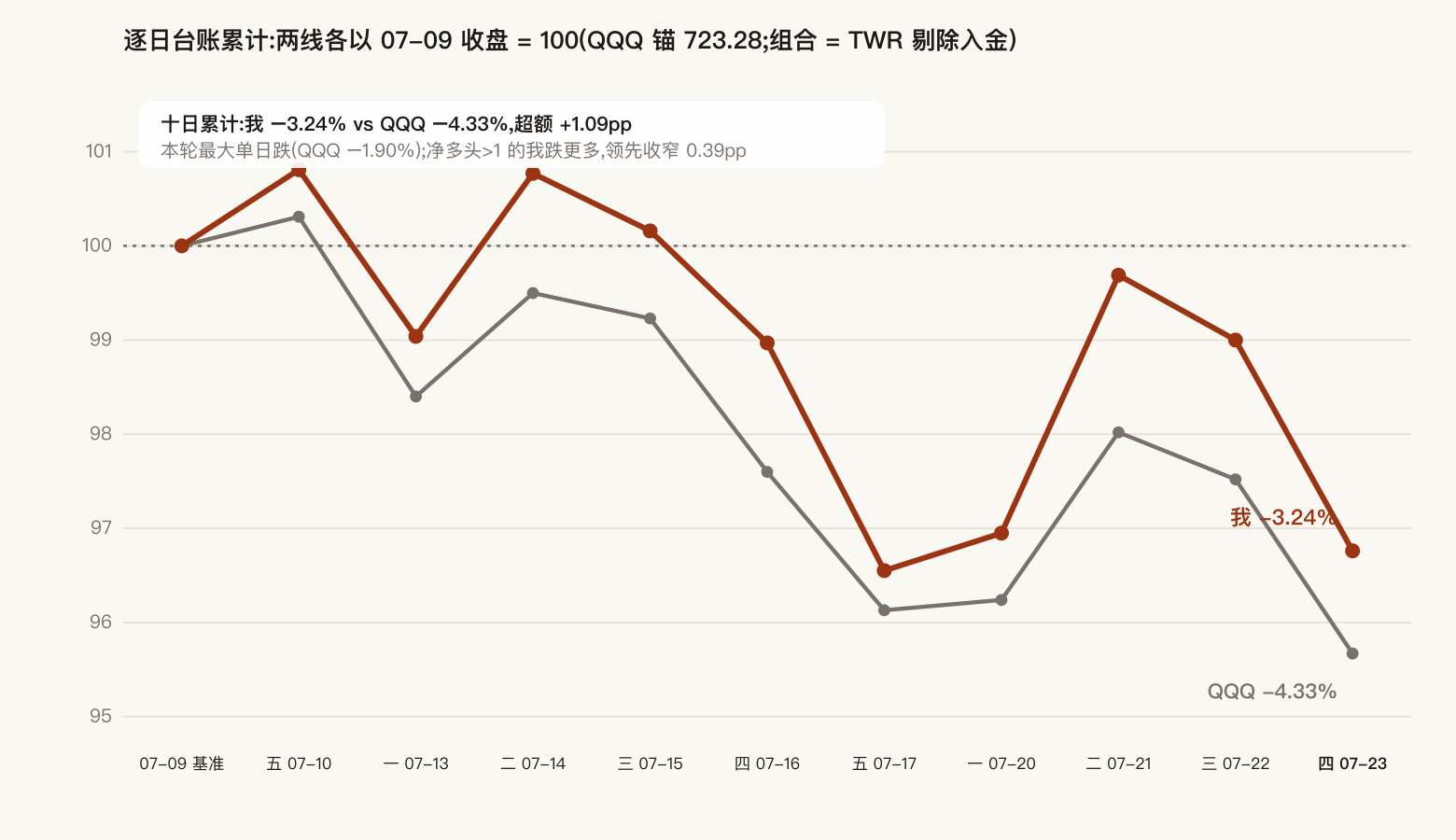
Indexed to July 9's close = 100: me −3.24% vs QQQ −4.33%, +1.09pp of excess. The biggest red day of the run hammered both lines; mine fell more, and the lead narrowed from +1.48pp to +1.09pp.
The pattern is now unmistakable: the lead is earned on down days (the cushion) and partly refunded on big down days (the leverage). A car with softer suspension still feels the big potholes.
4. Intel lands — just below the cap
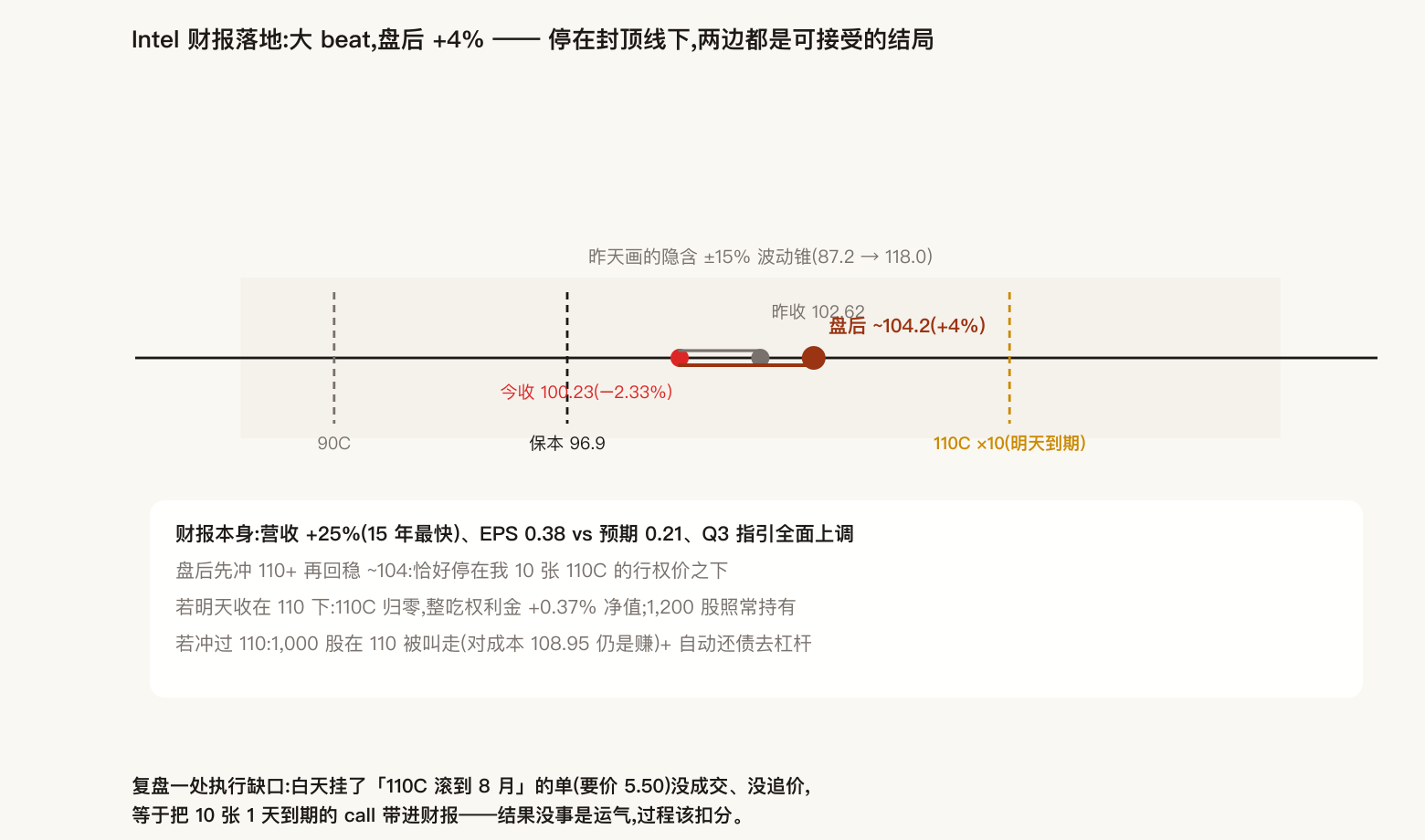
Yesterday's ±15% implied-move cone got its answer tonight. Intel Q2: revenue $16.1B, +25% — fastest growth in nearly 15 years, a 12% beat; EPS $0.38 vs $0.21 expected; Q3 guidance raised across the board. The stock spiked above 110 after hours, then settled around ~104 (+4%).
For my position this is nearly the most comfortable page in the script: 10 calls at the 110 strike expiring tomorrow, and the after-hours price sits just under it — close below 110 tomorrow and those 10 calls expire worthless, full premium kept, +0.37% of net worth, 1,200 shares intact; punch through 110 and 1,000 shares get called at 110 (still a gain against the 108.95 basis) plus automatic deleveraging. Both endings acceptable — that's the point of walking into earnings covered: you trade "guessing the direction" for "two scripts you can live with."
But a review grades the process, not the outcome: during the day I posted a roll of the 110Cs out to August (asking 5.50 credit), it didn't fill, I didn't chase, and I cancelled before the close — which means I carried 10 one-day calls into an earnings night. Settling at 104 was luck; at 115 I'd have been pinned on a gamma cliff with zero time-value protection. A fine outcome doesn't excuse a broken process. Points deducted, in writing.
Tomorrow: the 110C settlement, and whether the two 90Cs go deeper ITM (assignment there = $18k of automatic debt paydown). One more number worth savoring: this Intel program, rolled since May, now has an effective cost of −$8.48 per share — the premium collected exceeds what the shares cost. If the 110Cs and month-end 90Cs all get assigned and all 1,200 shares are called away, the program closes out at literally negative cost, coupons collected the whole way.
A formula that held for three straight days, two panic-discount notes, and an earnings print that stopped just under the cap — a full page in this book. And one new line in red on the discipline list: the pace of buying notes must not outrun the pace of capital being freed. The next note waits for the Aug 21 batch to expire.
RELATED
FOLLOW
New posts land here first. Subscribe via RSS: /feed.xml
AUTHOR
Tianli Zeng
Hydraulic engineer. I write about AI methodology, daily investment reviews, and engineering practice.